If you want your Dubai business website to rank on the first page of Google, on-page SEO is where that journey begins. Every page on your website sends signals to Google — through its title, headings, content, images, and structure — that determine where it ranks for your target keywords. On-page SEO is the process of optimising those signals to their maximum potential.
In this guide, RankUp UAE breaks down exactly what on-page SEO is, which elements matter most in 2026, and why Dubai businesses that neglect on-page fundamentals consistently underperform competitors who get them right.
Defining On-Page SEO
On-page SEO (also called on-site SEO) refers to all the optimisation work done directly on a webpage to improve its visibility in search engine results. Unlike off-page SEO (which involves external signals like backlinks), on-page SEO is entirely within your control — you own every element and can improve it at any time.
On-page SEO covers:
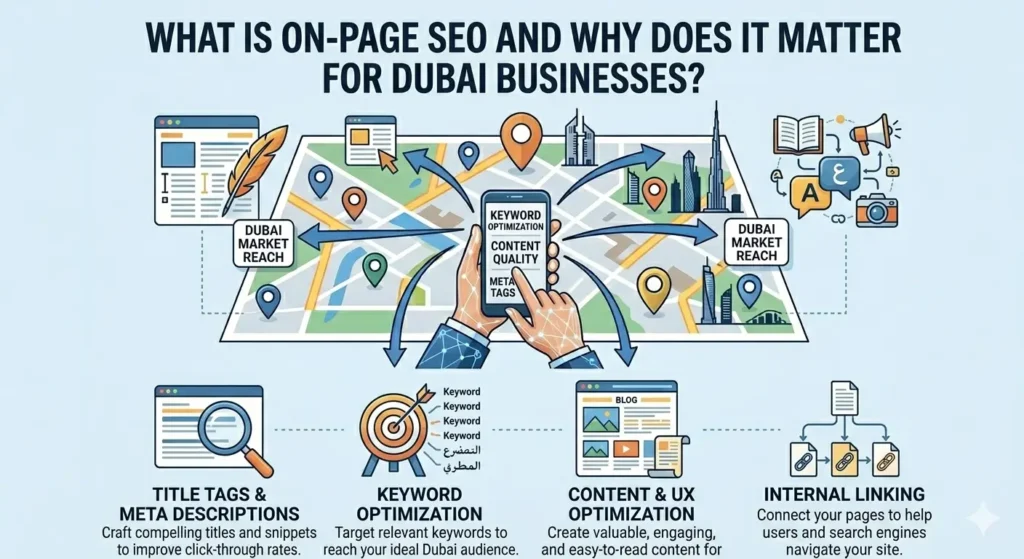
- Title tags — the clickable headline that appears in Google search results
- Meta descriptions — the summary text below your title in search results
- Heading structure (H1–H6) — the hierarchy of headings that organises your content
- Content quality, depth, and keyword optimisation
- Image alt text and file naming
- Internal linking between your pages
- URL structure and slug optimisation
- Page speed and Core Web Vitals
- Schema markup for structured data
- Mobile responsiveness
Why On-Page SEO Is the Foundation of Google Rankings
Google’s algorithm evaluates every page on your website before deciding whether to rank it — and for which keywords. No amount of link building or technical SEO work will rescue a page with poor on-page optimisation. The page-level signals Google reads first are on-page signals.
For Dubai businesses competing in a dense local search market, on-page SEO has three critical functions:
1. Relevance Signalling
Google needs to understand what your page is about before it can rank it for the right searches. On-page elements — particularly your title tag, H1, and body content — are the primary relevance signals Google uses to categorise your page. A page that clearly communicates “we provide emergency plumbing services in Business Bay, Dubai” will rank for emergency plumber Business Bay searches. A page with vague, unoptimised content will not.
2. User Experience Quality
Google’s Helpful Content system increasingly evaluates whether pages genuinely serve users’ needs — not just whether they include the right keywords. A well-structured page with clear headings, comprehensive information, and good readability satisfies users and earns lower bounce rates — which Google interprets as a quality signal.
3. Competitive Differentiation
In competitive Dubai markets, the businesses ranking on page one have not arrived there by accident. They have systematically optimised every on-page element. The difference between position 1 and position 7 for a valuable Dubai keyword is frequently the quality of on-page SEO rather than the quantity of backlinks.
The Most Important On-Page SEO Elements for Dubai Businesses in 2026
Title Tags
Your title tag is the single most important on-page element for keyword relevance. It should include your primary keyword, your business name, and ideally a location modifier. Format: “[Primary Keyword] + [Modifier] + [Brand] | [City]”. Example: “Emergency Plumber Business Bay Dubai | Al Baraka Plumbing”. Keep title tags under 60 characters to avoid truncation in search results.
H1 Heading
Your H1 is the main heading visible on the page itself. There should be exactly one H1 per page, and it should include your primary keyword naturally. Unlike the title tag (which exists in HTML but is not visible on the page), your H1 is the first thing visitors read — it should be both keyword-optimised and compelling for human readers.
Content Depth and Keyword Coverage
Google rewards pages that comprehensively cover a topic. For a Dubai plumbing service page, comprehensive coverage means addressing: what services you offer, the areas you serve (with specific Dubai neighbourhoods), how quickly you can respond, your qualifications, your pricing structure, what customers can expect, and the answers to common plumbing questions. This depth satisfies user intent and signals topical authority.
Meta Description
While meta descriptions are not a direct ranking factor, they significantly influence click-through rate — how often searchers click your result after seeing it. A compelling meta description for a Dubai business should include your primary keyword, a clear value proposition, and a call to action. Keep it under 155 characters.
Internal Linking
Internal links connect your pages together, distribute page authority across your site, and help Google understand your site’s structure and topic relationships. Every service page should link to related service pages, and your blog content should link to relevant service pages. This is one of the most underutilised on-page SEO tactics in Dubai.
Common On-Page SEO Mistakes Dubai Businesses Make
- Keyword stuffing: repeating keywords unnaturally, which Google penalises as spam
- Missing or duplicate title tags: every page needs a unique, keyword-optimised title
- H1 absent or used multiple times: one H1 per page, every time
- Thin content: pages under 400 words rarely rank for competitive Dubai keywords
- No internal linking: missed opportunity to distribute authority and guide users
- Images without alt text: Google cannot “see” images — alt text is the description it uses
On-Page SEO for Dubai Businesses: The RankUp UAE Approach
At RankUp UAE, every client campaign begins with a comprehensive on-page SEO audit of every page on the site. We identify every missing, duplicate, or underoptimised element — then implement improvements systematically, prioritising pages with the highest commercial value (service pages and location pages) before moving to supporting content.
Our on-page SEO implementation consistently produces measurable ranking improvements within 30 to 60 days — before significant link building or other off-page work is needed. Getting your on-page fundamentals right is the fastest, most controllable path to better Google rankings for any Dubai business.
Frequently Asked Questions
What is the difference between on-page SEO and off-page SEO?
On-page SEO covers everything you do on your own website — title tags, headings, content, internal links, speed, and schema markup. Off-page SEO covers external signals — primarily backlinks from other websites. Both are essential: on-page SEO without off-page authority limits how high you can rank; off-page authority without on-page optimisation wastes the opportunity that authority creates.
How often should on-page SEO be updated for Dubai websites?
Core on-page elements (title tags, H1s, meta descriptions) should be reviewed whenever you add new services, target new Dubai areas, or notice ranking drops. Content should be refreshed annually at minimum. Competitive Dubai markets require more frequent updates — quarterly reviews of your highest-value pages are recommended to maintain rankings as competitors continue optimising.